
By Richard Savoie, Founder, Adiona. PepsiCo Greenhouse Program APAC alum.
As a founder, I’ve seen firsthand how hard it has become for climate tech startups to raise traditional venture capital in what many call a funding winter for traditional VC investment in climate and agrifoodtech.
That challenge is especially real for businesses building technology that depends on deep research and development. Climate tech takes time. It can take years to test, prove, and scale a solution before the commercial results are fully visible. For investors looking for fast, predictable returns, that timeline can be a difficult fit.
For startups like Adiona, that makes non-dilutive funding an important part of the growth journey. But in my experience, the best non-dilutive support offers more than capital alone. The real value comes from access: to customers, to mentors, to internal champions, and to real-world problems your technology can help solve.
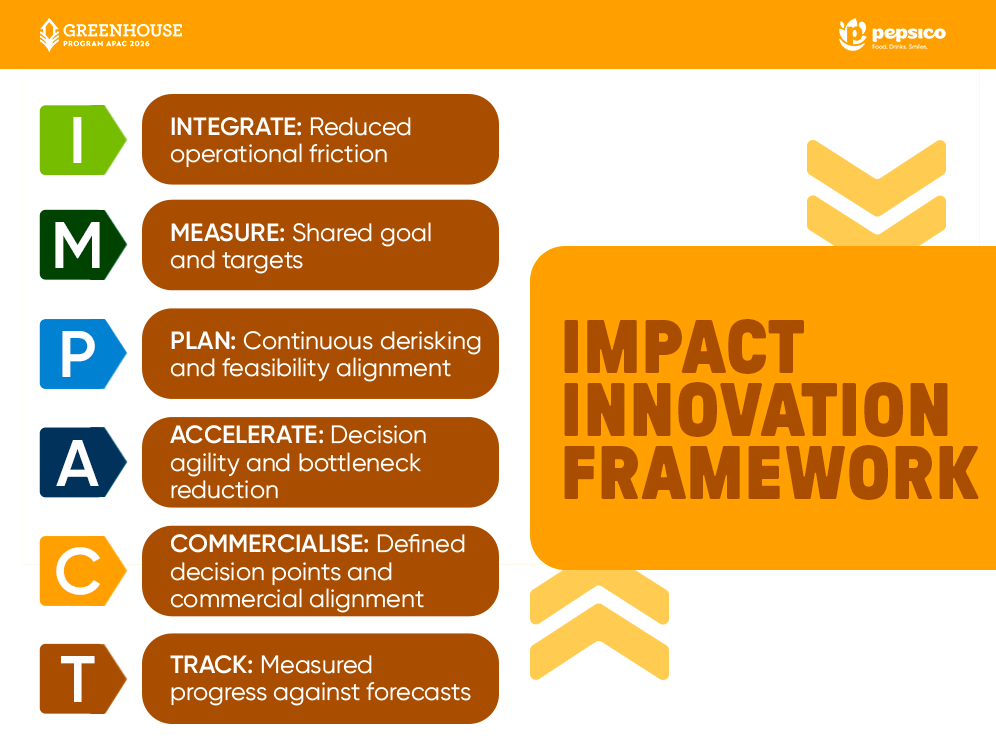
Our business first joined the PepsiCo Greenhouse Program APAC in 2023. I saw how a corporate-backed program could drive value for my business compared to traditional startup funding. It’s not just about backing innovation for innovation’s sake. It’s about giving startups the chance to engage with a large organisation in a practical way, test where they can create value, and build relationships that can help move a business forward. We have been selected for this year’s PepsiCo’s Greenhouse APAC Program: The IMPACT Edition which aims to take the thesis further, shifting the focus from pilots to integrating solutions across climate, agriculture and circularity into PepsiCo’s day-to-day APAC operations with the potential to expand globally.
Below are some of the key lessons I’ve taken from Adiona’s experience with non-dilutive corporate partnerships, including the PepsiCo Greenhouse Program:
🤝 Non-dilutive funding delivers the most value when paired with strategic access: Introductions, credibility, customer pathways and internal champions are just as critical as capital itself.
🏢 Corporate-backed support is different from startup ecosystem funding: Unlike VC-led programs focused on rapid scale and disruption, corporate initiatives invest in solutions they can realistically use, pilot, or offer to customers.
🎯 The best non-dilutive relationships are tied to a real business problem: Startups get more value when the corporate partner sees them as a practical solution, not simply an innovation “showcase”.
👥 Success depends on understanding who drives outcomes inside the organisation: Founders should get to know who can influence, sponsor, or unblock progress.
🌟 Internal advocates can be as valuable as the funding itself: Strong champions or mentors can make introductions, alleviate operational friction, and keep momentum alive.
🔄 Non-dilutive partnerships work best when there is mutual value: Founders should think about how to help corporate partners succeed internally, not just about what they want to gain from the relationship.
⚡ Reducing friction is essential in corporate relationships: The easier both parties make integration or implementation, the more likely the relationship is to achieve impact.
Richard Savoie is the founder of Adiona, an AI-powered delivery network design, route planning and fleet electrification platform helping the world’s biggest brands to deliver more efficiently with less carbon emissions. Adiona is one of five alumni startups selected for the PepsiCo Greenhouse Program APAC 2026: The IMPACT Edition. This year’s cohort brings together solutions spanning climate, agriculture and circularity systems.
Case Study: Discover how New Energy Transport completed Australia’s first heavy road freight delivery using an EV and Adiona