

Corporate–startup partnerships rarely fail because technology is unpromising. More often, they stall because two organisations that need one another are built to work in fundamentally different ways.
Corporate-startup engagement has established itself at the center of enterprise innovation. Some 67% of corporate executives rate startup collaboration as “important” or “mission critical” to their overall strategy[1], while 75% of Fortune 100 companies have built active corporate venture capital arms[2].
On paper, the alignment is ideal: established corporations seek fresh technological breakthroughs, while agile startups need the validation, infrastructure, and capital that large organisations can provide. In practice, however, bridging these two worlds remains notoriously difficult.
Research from IESE Business School suggests that approximately 70% of collaborations stall at the proof-of-concept stage without delivering expected returns[3]. Data highlighted by the University of Cincinnati paints a similar picture, with only 15% of partnerships surviving for the long haul[4].
The primary problem is rarely a flawed product or poor technology. It is the friction created by fundamentally different ways of working. With Boston Consulting Group reporting that 45% of corporate leaders and 55% of startup founders leave partnerships feeling dissatisfied[5], organisations need to rethink how they collaborate if they want to turn short-term pilots into long-term commercial value.
True collaboration extends far beyond disruptive technology or investing capital. It requires both parties to align their teams and bridge deep operational, cultural, and structural divides.
The strategic motivation is undeniable. Corporations consistently cite several drivers for startup collaboration, including creating strategic impact, accessing emerging technologies, exploring new business models, advancing sustainability goals, and securing long-term financial returns[6],[7]. Yet differences in how both sides operate create natural barriers, requiring each to adapt and compromise.
Culture, Governance, and Alignment: Why Partnerships Fail from Within
While many factors can influence the outcome of a corporate–startup partnership, some of the most critical failure points are internal. Resistance to change, resource allocation, and cultural differences can all prevent a promising collaboration from progressing[8].
A corporation is a complex ecosystem of individuals, business units, established cultures, formal structures and risk-conscious governance. Making a startup collaboration work requires addressing friction across all these areas — not simply a top-down directive.
In practice, startup engagements usually arise to solve a specific operational gap within a particular business unit. For the partnership to succeed, that unit must be deeply committed. Too often, however, collaborations are driven by centralised innovation teams, such as corporate venture capital arms, venture builders or accelerators, leaving the business unit as a passive recipient. Without direct ownership, it becomes easy for the project to be deprioritised.
It is also easy to overlook the resources startup engagement requires and the unfamiliar risks it may introduce. Corporate governance is designed to maximise value while minimising risk, and this mandate is reflected in business-unit KPIs. Yet those KPIs rarely account for the additional time, resources or risks involved in integrating a startup solution.
This creates a fundamental difference in pace. A startup must move quickly and take calculated risks to find product-market fit before its cash runway expires. A corporation, meanwhile, must manage risk through detailed governance, procurement and compliance processes. Neither approach is inherently wrong, but without realistic expectations, the mismatch can create frustration on both sides.
Successful collaboration may also require a cultural shift. Internal teams might resist external solutions because of the “not invented here” mindset, particularly where pride, prestige or financial incentives favour developing intellectual property in-house.
Senior corporate leaders may view younger startup teams as lacking enterprise experience, which can erode the mutual trust required to create value together.
Best Practices for Strategic Alignment & Success
Before launching a corporate-startup engagement, the corporation must align internally around a clearly defined use case and business need. Collaborations launched primarily out of curiosity or broad exploration can quickly lose executive support when corporate priorities change.
To limit initial risk and resource requirements, organisations can establish sandbox environments in which to test specific, relatively low-friction projects. This will not be feasible for every business model, particularly capital-intensive engagements requiring substantial upfront investment. However, the principle remains relevant: the first phase should be designed around a clear objective and a defined opportunity to learn.
Execution also depends heavily on people. Successful collaboration requires dedicated talent with an entrepreneurial mindset who can navigate the cultural friction between established corporate processes and agile startups.
Designating an “innovation champion” within each relevant business unit can create an important bridge between corporate operations, internal innovation teams and external partners. Organisations should also establish clear internal ownership and, where appropriate, align team objectives or KPIs with the collaboration’s success,
Corporate venture capital arms are also increasingly deploying dedicated business development teams to connect business units with startups, identifying potential synergies and resolving barriers that can prevent a partnership from progressing[9]. By working closely with both sides, these teams can help institutionalise a function that might otherwise depend on individual relationships or ad hoc support.
From a Promising Pilot to Commercial Value
When executed effectively, corporate-startup collaboration can transform an organisation’s innovation capacity. Companies gain access to agile external teams, specialised expertise and emerging technologies beyond the limits of internal research and development. At a time when technology lifecycles are shrinking and market conditions are changing rapidly, this access can help companies remain competitive and respond to new challenges.
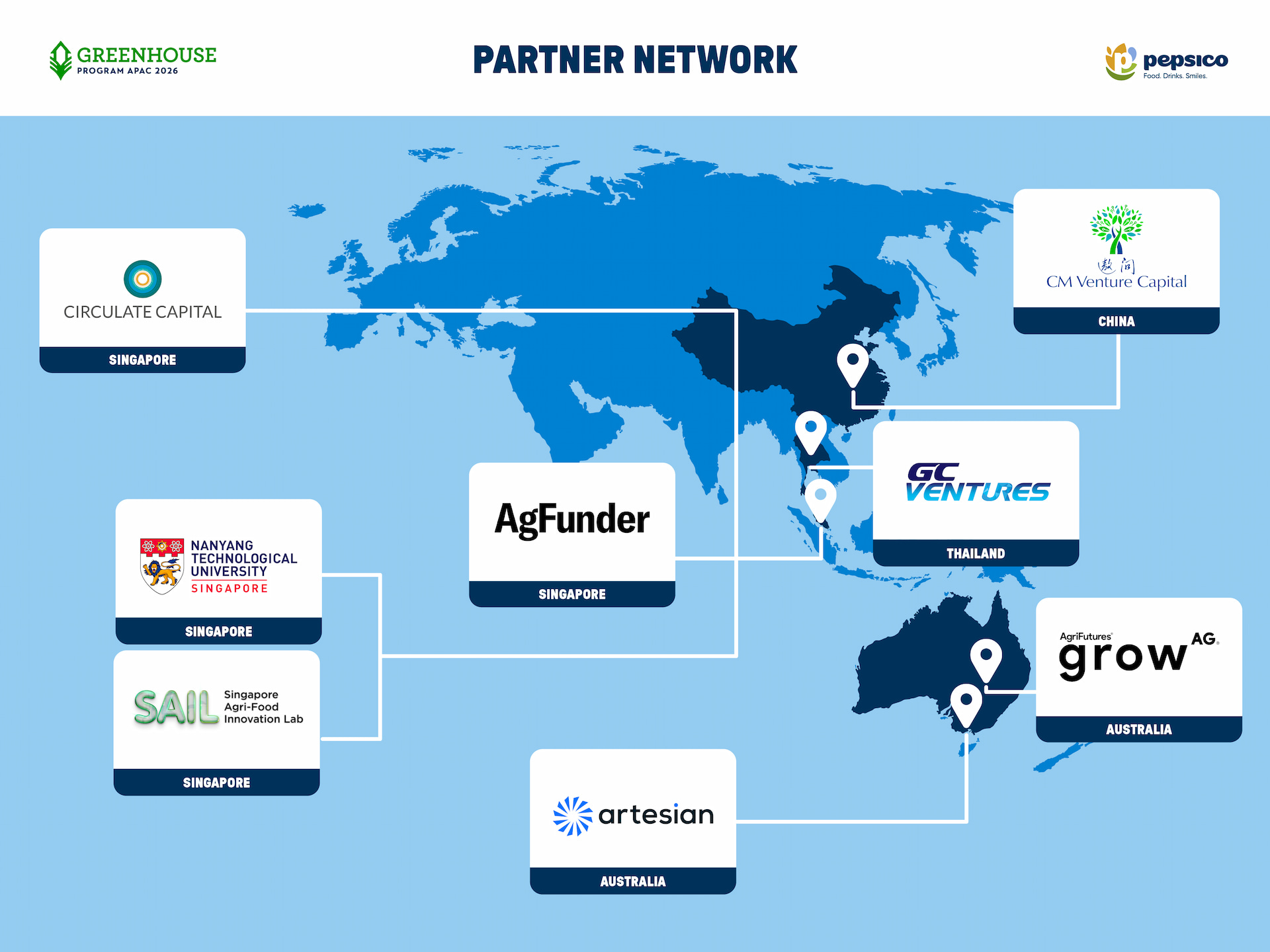
Strategic ecosystem partnerships further amplify these efforts. GC Ventures is partnering with PepsiCo’s Greenhouse Program APACV 2026: The IMPACT Edition to help advance sustainable solutions across the value chain.
As a hands-on program where innovators can engage directly with corporate decision-makers, the Greenhouse Program provides startups with access to corporate resources, structured mentorship, relevant business units and real-world feedback. This can help founders better understand what their solutions must demonstrate to progress from a promising pilot towards meaningful commercial adoption.
A startup from a previous Greenhouse cohort proved particularly relevant to GC Ventures and our core business. The startup was developing novel biopolymers, prompting the creation of a dedicated sandbox for further engagement.
The next challenge is to align the right strategic partners and build the supply chain capabilities needed to scale innovations such as these.
Ultimately, a successful corporate-startup partnership is not simply an investment or an opportunity to test new technology. It requires strategic alignment, committed internal owners, shared incentives and a practical route from experimentation to commercial value.
When those elements come together, corporations and startups have a far better chance of building partnerships that last.
Sources:
- The Open Innovation Report 2023
- How to make investments in start-ups pay off | McKinsey (2022)
- How to find your ideal startup to innovate with corporate venturing | IESE Insight
- The playbook for lasting corporate-startup partnerships – University of Cincinnati: Founder of Co-op, Leader in Co-op | University of Cincinnati
- Making Corporate-Startup Relationships Work | BCG
- Best practices for navigating the corporate-startup relationship | e27
- Open Innovation Outlook 2024, Mind the Bridge
- Measure everything and keep egos in check — the secret to startup collaboration – Global Venturing
- Why business development is CVC’s latest hot-ticket role – Global Venturing